Many beginner data scientists fall into the trap of thinking that data cleaning, feature engineering, and model training are the only steps in the journey. While these are critical, a model that lives only in a laptop provides zero value to the real world. To truly become an ML engineer, you must master the Deployment Stage.
In the concept of MLOps (Machine Learning Operations), we follow a cycle that transforms a research project into a production-ready application. This cycle is often divided into three distinct phases:
The Design Stage
This is where the foundation is laid. You aren't just writing code; you are working with business stakeholders to define the Use Case. You must answer: What problem does this solve? Who is the end-user? How will we test success? Designing the application's architecture here saves hours of "scrambling" later.
Essentially, this stage answers the question:
What exactly are we building, and how will we know it works?
The Development Stage
Once the blueprint is ready, you move to development. This is the familiar territory of building the model, but with a focus on reproducibility. You use the templates from the design stage to ensure your code is modular and ready for the next step.
This is where machine learning engineers and data scientists:
-
Prepare datasets
-
Train machine learning models
-
Build APIs
-
Create web applications or interfaces
-
Integrate the model into a usable system
This stage is what most beginners focus on — and understandably so. It involves model building, experimentation, and coding.
However, a powerful model sitting on your laptop creates no real-world value.
The Deployment Stage
The deployment stage is where the machine learning application is made available to the public. However, deployment isn't a "one and done" event. It is a reiterative process. Monitoring how users interact with your model in the wild often leads you back to the design stage for improvements.
Deployment typically happens on cloud platforms, which provide the infrastructure required to run applications reliably at scale.
The Problem Many Beginners Face
From my observation, many beginners spend most of their time on model building and experimentation, but when it comes time to actually deliver a working application, they struggle.
They suddenly realize they need to figure out:
This often leads to last-minute scrambling.
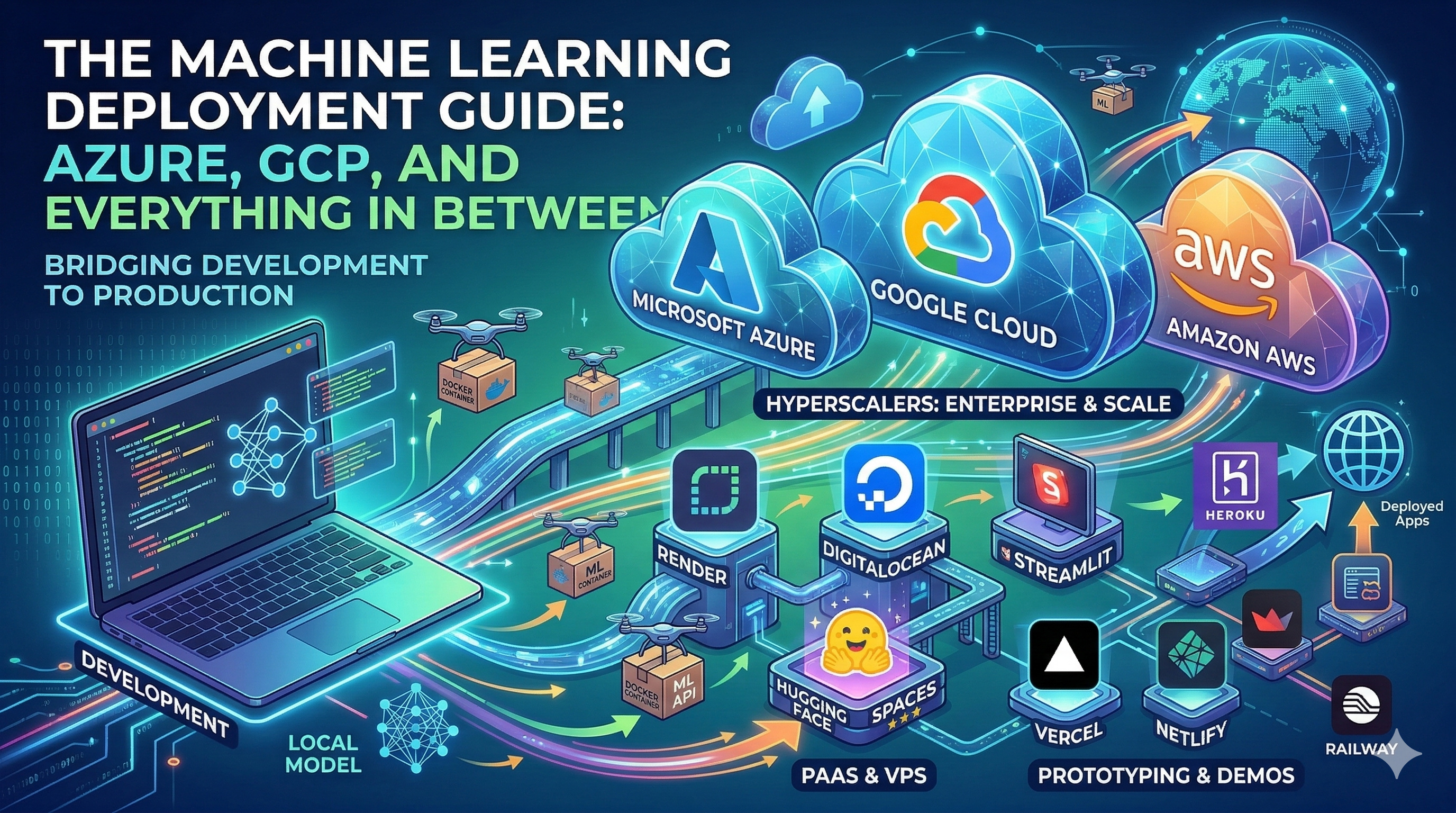
The goal of this blog is to introduce you to some of the major cloud platforms that can be used to deploy machine learning applications.
To make things easier, I have grouped them based on how they are commonly used by ML engineers.
The Industry Titans: The Hyperscalers
In the cloud computing industry, three companies dominate the space with massive global infrastructure and enterprise-grade services. These are often referred to as the hyperscalers.
They provide everything from raw computing power to advanced machine learning platforms.
If you are looking for industrial-standard robustness and the ability to scale to millions of users, you look to the "Big Three." These platforms offer the most certificates and are the gold standard for enterprise jobs.
AWS is the largest and most widely used cloud platform in the world. It offers hundreds of services that allow developers to build, deploy, and scale applications.
For machine learning engineers, AWS provides several tools useful for deployment:
-
EC2 – virtual machines for hosting applications
-
S3 – object storage for datasets and models
-
Lambda – serverless execution
-
Elastic Beanstalk – simplified application deployment
-
SageMaker – end-to-end machine learning platform
For example, a typical ML deployment pipeline on AWS might look like:
Model → Docker container → API → EC2 or SageMaker endpoint.
AWS is extremely powerful but can sometimes feel overwhelming for beginners because of the large number of services available.
Azure is Microsoft's enterprise cloud platform and is particularly popular in organizations that already use the Microsoft ecosystem.
Azure is often considered one of the most enterprise-friendly platforms, especially for companies that rely heavily on tools like Microsoft 365 and enterprise identity systems.
For ML engineers, Azure provides tools such as:
-
Azure App Service for hosting web applications
-
Azure Container Apps for containerized deployments
-
Azure Functions for serverless execution
-
Azure Machine Learning for model training and deployment
-
Azure Kubernetes Service (AKS) for scalable ML services
Azure is often considered one of the most enterprise-friendly platforms, especially for companies that rely heavily on tools like Microsoft 365 and enterprise identity systems.
Google Cloud Platform has become a favorite for AI engineers due to its unified platform, Vertex AI. Unlike other clouds that feel like a collection of separate tools, Vertex AI brings together data engineering, model training, and deployment in one place.
Some of the key tools used for ML deployment include:
-
Cloud Run – serverless container deployment
-
App Engine – managed web application hosting
-
Compute Engine – virtual machines
-
Vertex AI – Google’s end-to-end ML platform
GCP is especially popular among AI startups and research-focused teams, largely due to Google's expertise in AI infrastructure.
Platform as a Service(PaaS): Simplicity Meets Control
Not every ML engineer wants to manage cloud infrastructure.
Sometimes you just want to deploy an application quickly without worrying about servers.
This is where Platform as a Service (PaaS) solutions come in. These platforms handle infrastructure management while you focus on your application.
Render is often the first place developers go when moving away from Heroku. It offers a "GitHub-native" experience—you simply link your repository, and it builds and deploys your app automatically.
It allows developers to easily deploy Web services, APIs, Background workers, Static sites and Databases.
For ML engineers deploying Flask or FastAPI applications, Render provides a simple workflow:
Push code → connect GitHub → automatic deployment.
It also supports Docker deployments, which makes it suitable for containerized ML services.
Northflank is a modern cloud platform focused on containerized applications.
It allows developers to deploy services using Docker containers, Git repositories and CI/CD pipelines.
It offers a Bring Your Own Cloud (BYOC) model. This means you can use Northflank's beautiful UI to manage your apps, but the actual servers run on your own GCP or AWS account. This gives you the control of a Hyperscaler with the ease of a specialized host.
DigitalOcean is known for its simplicity and predictable pricing.
Its most famous offering is the Droplet, which is essentially a Virtual Private Server (VPS).
With a droplet you can Install Python, Run FastAPI or Flask servers, Host ML models and Configure your own infrastructure.
DigitalOcean is great for developers who want more control than other PaaS platforms but without the complexity of hyperscale clouds.
Heroku was historically one of the most beginner-friendly deployment platforms.
Developers could deploy applications with a simple command like:
However, Heroku no longer offers a free tier, which has pushed many developers toward alternatives like Render.
Despite this, Heroku remains a reliable platform for hosting small web applications and APIs.
Prototyping Platforms: Where Experiments Live
Sometimes your goal is not to build a production system immediately.
Instead, you may want to:
These platforms are built specifically for data scientists to share their work without needing to know a single line of HTML or CSS.
Streamlit Community Cloud is arguably the fastest way to deploy a machine learning demo.
With just a few steps you can:
It is widely used by data scientists to showcase:
-
dashboards
-
model demos
-
interactive data apps
For portfolios and hackathon projects, Streamlit Community Cloud is often the gold standard.
You push your Python script to GitHub, and Streamlit Community Cloud hosts it for free. It is the fastest way to get a URL you can put on your LinkedIn profile or resume.
Hugging Face Spaces is currently one of the best platforms for hosting machine learning demos.
It supports applications built using:
It is especially popular among ML engineers who want to showcase:
-
NLP models
-
computer vision demos
-
generative AI tools
It allows you to host your model weights on the Hugging Face Hub and connect them directly to your Space. It even offers paid upgrades for GPU access if your model is too heavy for a free CPU.
Specialized Cloud Platforms
Some platforms are designed with specific types of applications in mind.
They may not be ideal for full ML backends, but they can be very useful for frontends and static deployments.
Vercel is optimized for modern frontend frameworks, particularly:
It provides extremely fast deployment and excellent developer experience.
However, The Vercel free plan, known as the Hobby plan, allows for a maximum of 100 MB for static file uploads and has a build cache maximum size of 1 GB. which means it is usually better suited for frontend interfaces that connect to a separate ML API.
Netlify specializes in hosting static websites and Jamstack applications.
Developers commonly use it to host:
-
documentation sites
-
frontend dashboards
-
marketing pages
In ML projects, Netlify is often used to deploy the frontend of an application, while the model inference API runs on another platform.
A Few Other Notable Platforms
Railway is a modern deployment platform that focuses on simplicity and developer experience. It is particularly good for quickly deploying APIs and small ML services.
Fly.io allows developers to deploy Docker containers close to users globally, which can be useful for latency-sensitive ML inference services.
Machine Learning Deployment Platforms Comparison
| Platform |
Category |
Best Use Case |
Difficulty Level |
Free Tier |
| Amazon Web Services (AWS) |
Hyperscaler |
Large scale ML systems, enterprise production deployments |
Advanced |
Limited free tier |
| Microsoft Azure |
Hyperscaler |
Enterprise ML systems, integration with Microsoft ecosystem |
Advanced |
Limited free tier |
| Google Cloud Platform (GCP) |
Hyperscaler |
AI/ML workloads, scalable APIs, data pipelines |
Advanced |
Limited free tier |
| Render |
PaaS |
Deploying Flask/FastAPI ML APIs quickly |
Beginner Friendly |
Yes |
| DigitalOcean |
VPS / Cloud Infrastructure |
Hosting ML APIs with more infrastructure control |
Intermediate |
No permanent free tier |
| Northflank |
Container-based PaaS |
Deploying Dockerized ML services and microservices |
Intermediate |
Yes |
| Heroku |
PaaS |
Simple web app or API deployment |
Beginner Friendly |
No free tier |
| Streamlit Community Cloud |
Prototyping Platform |
Deploying ML dashboards and demos |
Very Easy |
Yes |
| Hugging Face Spaces |
ML Hosting Platform |
Hosting ML demos with Streamlit or Gradio |
Very Easy |
Yes |
| Vercel |
Frontend Hosting Platform |
Hosting ML application frontends (React/Next.js) |
Beginner Friendly |
Yes |
| Netlify |
Static Hosting Platform |
Hosting dashboards, docs, or ML app frontends |
Beginner Friendly |
Yes |
| Railway |
PaaS |
Quickly deploying APIs and small ML apps |
Beginner Friendly |
Yes |
| Fly.io |
Container Hosting Platform |
Deploying Dockerized apps close to users globally |
Intermediate |
Yes |
Final Thoughts
Deployment is the stage where machine learning stops being an experiment and starts becoming a real product.
Understanding cloud platforms allows you to:
If you are a beginner, you do not need to master every platform immediately.
A good progression could look like this:
-
Streamlit Cloud or Hugging Face Spaces for prototypes
-
Render or Railway for simple APIs
-
AWS, Azure, or GCP for production systems
Mastering deployment is what separates a model builder from a true machine learning engineer.